


Over the last six articles, we have journeyed through the technical and aesthetic world of terracotta dot art. We have explored the sacred geometry of Mandalas, the playful storytelling of Whimsical Folk Art, and the modern sophistication of Monochrome Designs. We have even geeked out over the specific Tools and Sealers required to make the paint stick.
But there is one final, crucial ingredient that we haven't discussed. It is the ingredient that separates a mass-produced decal plate from a piece of genuine art.
That ingredient is the human hand.
Specifically, the hands of the Balinese artisans who create these collections for Budivis. Today, we are taking you behind the scenes, into the open-air workshops of Bali, to understand why this island is the perfect breeding ground for such intricate, patient work.

Art as Devotion: The Balinese Advantage
Visitors to Bali often remark that "everyone here is an artist." Whether it is wood carving, stone sculpting, or painting, the island seems to hum with creativity. But this isn't just a hobby; it is a cultural necessity.
In Hinduism, the predominant religion of Bali, daily life is structured around rituals. Every morning, Balinese women create Canang Sari—intricate daily offerings made from woven palm leaves and carefully arranged flower petals.
- The Connection: Think about the dexterity required to weave a tiny basket and arrange flower petals by colour and direction every single morning. This lifelong training in patience, precision, and colour balance translates perfectly to dot painting.
- The Mindset: For a Balinese artisan, repetitive motion is not "boring"; it is meditative. Painting thousands of tiny dots on a terracotta plate requires a state of flow that is very similar to prayer. This is why the lines are so steady—they are painted with a calm mind.

- Inside the Workshop: No Conveyor Belts Here
If you imagine a "factory" where these plates are made, erase that image. The Budivis production centres are traditional family compounds or small community workshops.
Instead of the hum of heavy machinery and fluorescent lights, you will find:
- Open Air: Artisans sit cross-legged on bamboo mats or at low tables in open-sided pavilions (bale), enjoying the natural breeze.
- Community: It is a social environment. Men and women work together, chatting while their hands move rhythmically. The vibe is relaxed, not rushed.
- Natural Rhythm: Work often pauses for temple ceremonies or village obligations. This balance between work, life, and spirit is what prevents burnout and keeps the quality of the art high.
The Concept of "Taksu" (The Spirit of Art)

There is a word in Bali that has no direct English translation: Taksu.
Roughly, it means "spiritual charisma" or the "soul" of a performance or artwork. A dancer might have perfect technique, but if they lack Taksu, the audience feels nothing. A painting might be technically flawless, but without Taksu, it feels cold.
- Machine vs. Hand: A machine can print a perfect mandala pattern on a plate in seconds. The dots will be perfectly round and perfectly spaced. But it will feel "flat."
- The Human Touch: A hand-painted plate has tiny, microscopic imperfections. Maybe one dot is slightly higher than another. These aren't flaws; they are the signature of the artist. They prove that a human being spent hours focusing their energy on this object. That energy is Taksu. When a customer picks up a Budivis plate, they are subconsciously connecting with that human energy.
From the Kiln to the World: The Ethical Journey
At Budivis, we see ourselves as the bridge between these traditional village artisans and the global market. But building that bridge requires responsibility.
- Sourcing the Clay: We start with locally sourced terracotta clay, dug from the Indonesian earth. It is fired in local kilns, supporting the clay-making villages.
- Fair Trade Practices: We ensure that our artisans are paid fairly for their incredible skill. We do not demand impossible quotas that would sacrifice quality or worker well-being.
- Preserving Tradition: By creating a global demand for this specific style of dot art, we are giving young people in the villages a reason to stay and learn the craft, rather than leaving for the city to work in hospitality.
Conclusion: Why "Handmade" Matters
In a world filled with fast fashion and disposable decor, buying a piece of hand-painted terracotta is a small act of rebellion. You are choosing slow art.
When you display a Botanical Leaf Plate or a Geometric Mandala in your home (or sell it in your store), you aren't just buying a decoration. You are preserving a story. You are supporting a mother in Gianyar who paints while her children play nearby. You are valuing the patience it took to place 500 individual white dots on a bamboo stalk.
This concludes our series on Terracotta Dot Art. We hope these articles have inspired you to appreciate the complexity, beauty, and soul behind these humble clay plates.
Partner with Budivis: Bring the Soul of Bali to Your Store
Are you ready to offer your customers something with a story? Budivis is your trusted partner for wholesale Balinese handicrafts.
- Ethical Sourcing: We are committed to transparency and fair labour practices.
- Curated Collections: From the spiritual to the whimsical, our catalogue is diverse yet cohesive.
- Custom Capabilities: We can work with you to develop exclusive designs that fit your brand’s aesthetic.
- Global Logistics: We handle the complexity of export/import, making it easy for you to stock your shelves with authentic Balinese art.
Contact Budivis today to start your journey with us. Let’s bring a little bit of Taksu to the world, one dot at a time. Watch our live products here.
Related Products

Handmade Terracotta Decorative Plates, Dot Art Flower Mandala Terracotta Wall Plate
Wholesale Handmade Terracotta Decorative Plates, Dot Art Flower Mandala Terracotta Wall PlateEnhance your collection with our Hand Dot Painted Terracotta Wall Plate, 100% handmade in Bali by skilled artisans. Featuring intricate mandala, floral,...

Green Floral Dot Art Terracotta Table Top Decor, Hand Painted Terracotta Dot Mandala Wooden Keepsake Box
This Mandala Dot Art piece blends symmetry and artistic expression through handcrafted dotting techniques. Perfect for home decor stores and wellness retailers. Budivis offers wholesale pricing, custom design, private label packaging, and worldwide s...

Artisan Fruit Mandala Hand Dot Terracotta Decorative, Hand Dot Painted Fruit Mandala Terracotta Plate
Wholesale Artisan Fruit Mandala Hand Dot Terracotta Decorative, Hand Dot Painted Fruit Mandala Terracotta PlateEnhance your collection with our Hand Dot Painted Terracotta Wall Plate, 100% handmade in Bali by skilled artisans. Featuring intricat...

Black White Flower Handmade Dot Mandala Terracotta Plate – Dot Art Terracotta Decorative
Wholesale Black White Flower Handmade Dot Mandala Terracotta Plate – Dot Art Terracotta DecorativeEnhance your collection with our Hand Dot Painted Terracotta Wall Plate, 100% handmade in Bali by skilled artisans. Featuring intricate mandala, fl...

Classic Black Dot Art Terracotta Vase, Handmade Decorative Flower Vase, Hand Painted Terracotta Vases Dot Art
This Dot Art Keepsake Box combines functionality with artistic beauty, featuring detailed hand-painted dot patterns inspired by mandala and tribal designs. Perfect for storing jewellery and small accessories. Ideal for gift shops and resellers. Budivis...

Bamboo Dot Mandala Terracotta Decorative Plate, Nature-Inspired Terracotta Plate Wall Art
Wholesale Bamboo Dot Mandala Terracotta Decorative Plate, Nature-Inspired Terracotta Plate Wall ArtEnhance your collection with our Hand Dot Painted Terracotta Wall Plate, 100% handmade in Bali by skilled artisans. Featuring intricate mandala, f...

Coaster Dotwork Terracotta, Unique Coaster Dot Art, Handpainted Coaster
Wholesale Coaster Dotwork Terracotta, Unique Coaster Dot Art, Handpainted CoasterEnhance your collection with our Hand Dot Painted Terracotta Wall Plate, 100% handmade in Bali by skilled artisans. Featuring intricate mandala, floral, spiral, and...

Blue Petals Dot Painted Terracotta Plate, Handmade Dot Art Terracotta Wall Plates
Wholesale Blue Petals Dot Painted Terracotta Plate, Handmade Dot Art Terracotta Wall PlatesEnhance your collection with our Hand Dot Painted Terracotta Wall Plate, 100% handmade in Bali by skilled artisans. Featuring intricate mandala, floral, ...

Dot Art Flower on Star Mandala Terracotta Plate – Dot Art Terracotta Decorative Plates
Wholesale Dot Art Flower on Star Mandala Terracotta Plate – Dot Art Terracotta Decorative PlatesEnhance your collection with our Hand Dot Painted Terracotta Wall Plate, 100% handmade in Bali by skilled artisans. Featuring intricate mandala, flor...

Gecko Hand-Dotted Terracotta Wall Plate, Animal Terracotta Plates Wall Décor
Wholesale Gecko Hand-Dotted Terracotta Wall Plate, Animal Terracotta Plates Wall DécorEnhance your collection with our Hand Dot Painted Terracotta Wall Plate, 100% handmade in Bali by skilled artisans. Featuring intricate mandala, floral, spiral...
Related Blog

The Beginner’s Guide to Hand-Painted Terracotta: Mastering Dot Art & Mandalas
In the world of interior design, trends come and go, but the appeal of handmade, artisanal decor is timeless. There is something deeply grounding about bringing natural materials into our homes. Lately, one specific art form has captured the hearts o...
- 0
- 311

Perfect Dots Every Time: Best Paints, Tools & Techniques for Terracotta
If you have read our previous guides on Mandalas or Botanical Designs, you might have felt inspired to pick up a dotting tool and try it yourself. But if you have ever tried painting directly onto a raw terracotta plate, you likely enc...
- 0
- 387

Handcrafted Wooden Coaster Sets Premium Table Decor for Wholesale Buyers
Hand-Painted Blue Mandala Terracotta Disk Enhance your collection with this exquisite hand-dotted terracotta plate, featuring a vibrant blue mandala design meticulously crafted by Bali's finest artisans. A p...
- 0
- 274

Monochrome Elegance: Mastering Black & White Pointillism on Terracotta
In our previous explorations of terracotta art, we have celebrated colour—from the spiritual spectrum of Mandala Magic to the playful primary colours of Whimsical Folk Art. But sometimes, the most powerful statement you can make is the a...
- 0
- 302

Black Wooden Vase with Tribal Dot Art – A High-Demand Decorative Piece for Wholesale Buyers
Classic Black Dot Art Terracotta Vase Elevate your home decor collection with this exquisite handmade terracotta vase, featuring a sophisticated black dot art pattern meticulously applied...
- 0
- 255

Beyond Mandalas: Painting Whimsical Folk Art Villages on Pottery
While the precise geometry of a mandala can be deeply meditative, there is another side to terracotta art that is just as captivating: Storytelling.If you have mastered the basics from our Beginner’s Guide to Hand-Painted Terracotta, you kn...
- 0
- 298

Mandala Magic: Mastering Symmetrical Dot Art on Terracotta Plates
There is something undeniably hypnotic about a mandala. The word itself comes from Sanskrit, meaning "circle," and represents wholeness, eternity, and the universe. When applied to home decor—specifically through the technique of dot painting on...
- 0
- 330
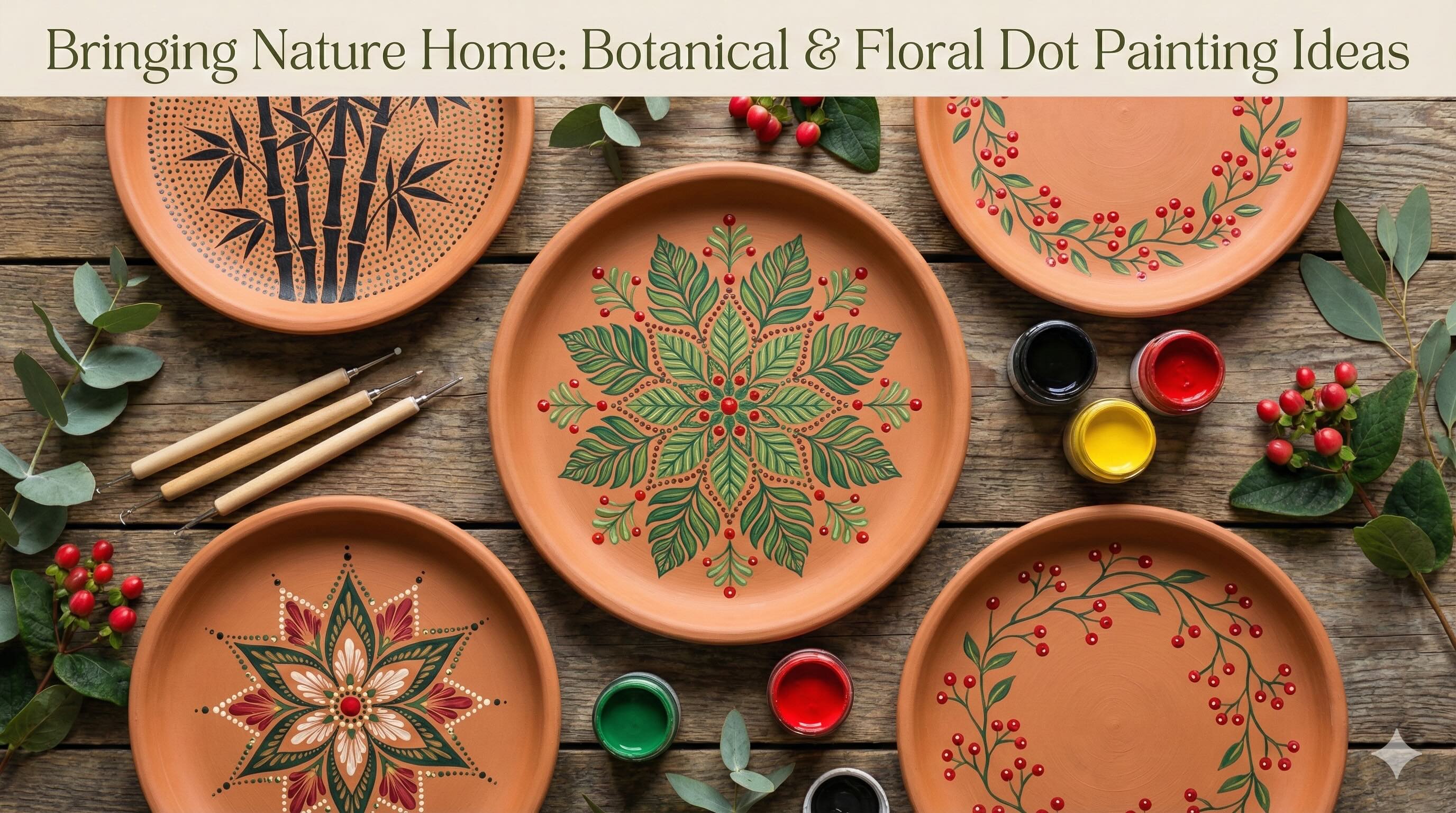
Bringing Nature Home: 5 Botanical & Floral Dot Painting Ideas for Terracotta
In the world of interior design, there is a concept known as Biophilic Design. Simply put, it is the practice of connecting people and nature within our built environments and communities. We see it in the explosion of houseplant popularity, the...
- 0
- 276