

In the world of interior design, there is a concept known as Biophilic Design. Simply put, it is the practice of connecting people and nature within our built environments and communities. We see it in the explosion of houseplant popularity, the use of natural wood furniture, and the rising demand for earthy colour palettes.
Terracotta pottery is, by definition, "baked earth." It is the perfect vessel for this trend. But when you combine the raw, rustic material of the clay with hand-painted botanical dot art, you create something truly special. You aren't just decorating a room; you are bringing the outdoors in.
In our previous articles, we explored the mathematical precision of Mandalas and the high-contrast drama of Monochrome Art. Today, we are softening the edges. We are looking at how the pointillism technique can be used to mimic the organic, flowing beauty of vines, flowers, and leaves.
Why Dot Art Mimics Nature Perfectly
 At first, you might think that "dots" are too rigid to capture the flow of a flower. But if you look closely at nature, you will see that it is often built from tiny points.
- Textures: The centre of a sunflower, the spores of a fern, or the texture of a strawberry are all essentially "dots."
- Atoms and Cells: Nature is built on clusters. Dot art mimics this cellular structure, making floral designs look vibrant and alive rather than flat and cartoonish.
Here are the top botanical styles we are seeing in the Budivis workshops, inspired by the lush tropical landscape of Bali.
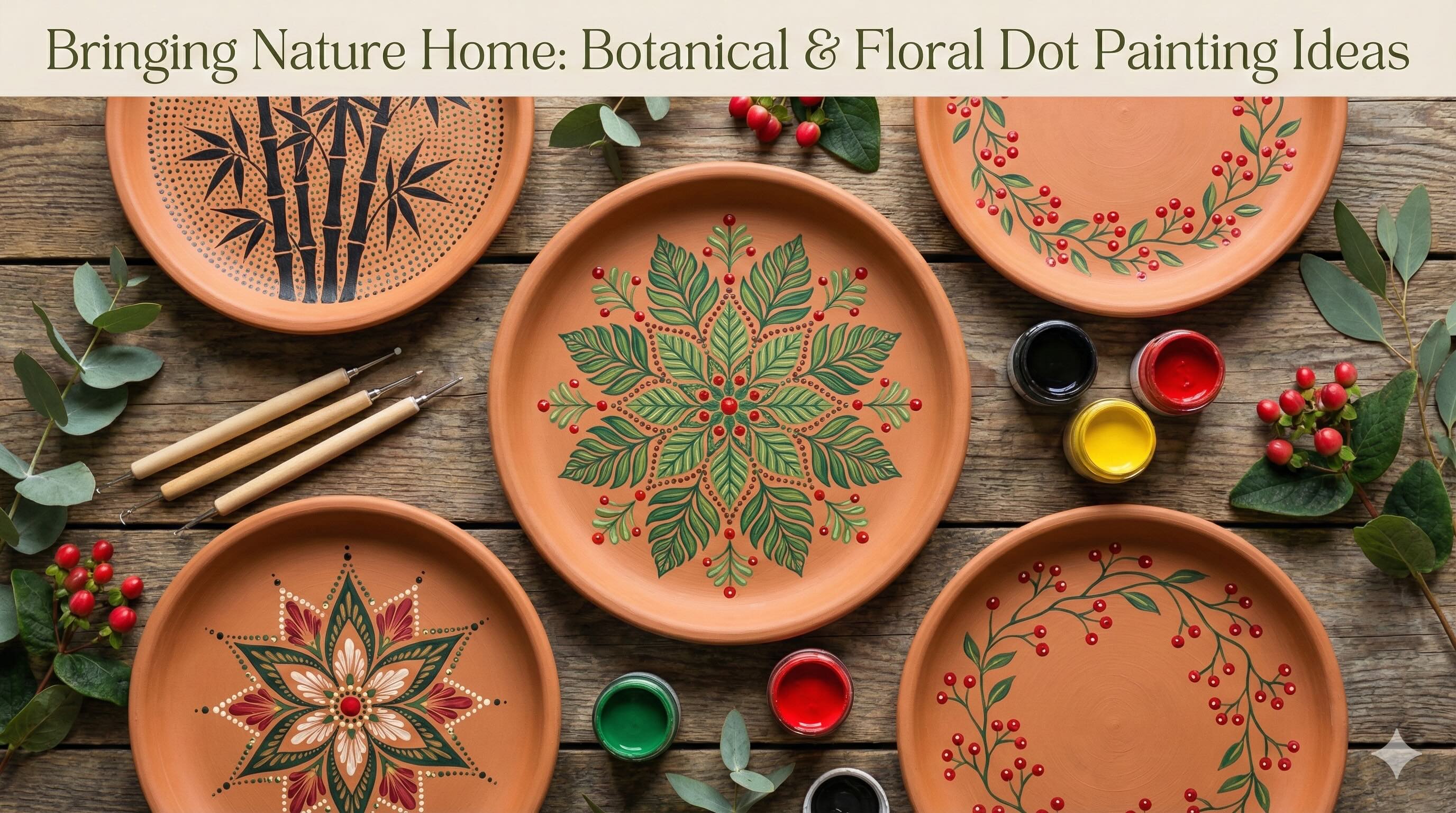
1. The Red Berry Vine: Asymmetry and Movement
Reference: The round plate featuring black vines with clusters of red berries.
This design is a favourite because it breaks the rules of symmetry. Unlike a mandala, which is centred, this design often sweeps across the plate in a curve, mimicking the way a vine grows up a trellis.
- The Palette: The background is usually left as raw terracotta or painted a soft cream. The vines are stark black, providing a skeleton for the design. The "berries" are created using the top-dot technique: a large dark red dot with a tiny white highlight on top to make it look juicy and three-dimensional.
- The Vibe: This design feels wild and uncontained. It is perfect for adding a sense of movement to a static shelf display.
2. The Green Leaf Mandala: Organised Nature
Reference: The plate featuring green geometric leaf patterns.
Can a mandala be botanical? Absolutely. This style creates a hybrid between the strict grid of a mandala and the shapes of a garden.
- The Shape: Instead of simple circles, the dots are arranged to form teardrops or marquise shapes that resemble leaves.
- The Gradient: This is where the artistry shines. To make a leaf look realistic using only dots, the artist uses a gradient of greens—starting with deep forest green at the centre of the leaf and fading out to lime green or yellow at the tips. This mimics the way sunlight hits foliage.
- The Vibe: This is "controlled nature." It is soothing and orderly, making it ideal for those who love plants but prefer a tidy, minimalist aesthetic.
3. The Bamboo Grove: Zen Simplicity
Reference: The bamboo designs (both coloured and monochrome).
We discussed the [Black & White Bamboo] in our monochrome article, but bamboo is fundamentally a botanical motif. In its coloured variations—using shades of olive and sage—it takes on a softer, more tranquil character.
- The Technique: Painting bamboo requires a mix of solid strokes (for the stalks) and delicate dotting (for the background or texture). The dots often represent the air or mist around the bamboo, creating a dreamy, atmospheric effect.
- The Symbolism: In many cultures, bamboo represents resilience and flexibility. Displaying this art is often seen as inviting good fortune into the home.
4. The Floral Star: The Centrepiece
Reference: The large central flower designs.
Sometimes, you want the flower to be the main character. These designs feature a single, massive bloom that takes up the entire plate.
- The Anatomy: The centre of the plate becomes the pistil of the flower, often detailed with hundreds of tiny gold or yellow dots to look like pollen. The petals radiate outward, getting larger as they reach the rim.
- The "Lace" Effect: By using white dots on a dark background (or vice versa) within the petals, the flower takes on a lace-like quality. It looks delicate, almost like an embroidered doily, but with the weight and substance of pottery.
Styling Botanical Terracotta
 How do you integrate these earthy pieces into your home? The key is to pair them with living elements.
- The "Plant Shelfie": Place a Red Berry Vine plate on a shelf next to a trailing Pothos or Ivy plant. The painted vines on the plate will visually connect with the real vines of the plant.
- The Garden Room: If you have a sunroom or a patio, these plates are durable enough to be displayed (under cover). The terracotta material withstands humidity well, and the botanical themes bridge the gap between your garden and your furniture.
- Dining Tablescapes: Use the Green Leaf Mandala plates as chargers (decorative base plates) for a garden-party-themed dinner. Pair them with linen napkins and fresh flower centrepieces.
The Artist’s Challenge: Capturing "Organic" with Tools

For our artisans at Budivis, botanical designs offer a unique challenge. With a geometric mandala, if you mess up a count, the symmetry is broken. With botanical art, the challenge is flow.
To make a branch look like it is swaying in the wind using only rigid tools requires a deep understanding of negative space. The artist must know when not to place a dot. The empty clay space is just as important as the paint; it represents the air and the earth that allows the plant to breathe.
Conclusion
Botanical dot art is a celebration of life. It combines the grounding energy of the earth (the clay) with the vibrant, growing energy of plants (the design). Whether you prefer the wild asymmetry of a berry vine or the structured beauty of a leaf mandala, these pieces remind us of the intricate details found in the natural world.
In our next and final article, we will discuss the practical side of things: Tools, Care, and Durability, ensuring your botanical beauties last a lifetime.
Partner with Budivis for Your Decor Needs
Are you a retailer looking to capitalize on the "Biophilic Design" trend? Budivis offers a stunning range of botanical terracotta art, handmade in Bali.
- Affordable Wholesale: We provide competitive pricing for bulk orders, allowing you to offer high-value artisanal goods to your customers.
- Custom Design: Do you have a specific flower native to your region? A state flower? We can create custom designs to resonate with your local market.
- Private Label & Packaging: We offer full private labelling services, so the product arrives ready to sell under your own brand.
- Worldwide Shipping: We handle all logistics, ensuring your pallets of pottery arrive safely at your doorstep, anywhere in the world.
Contact Budivis today to browse our Botanical Collection and bring a piece of the Balinese garden to your store. Check out our live demo product:
Related Products

Black White Flower Handmade Dot Mandala Terracotta Plate – Dot Art Terracotta Decorative
Wholesale Black White Flower Handmade Dot Mandala Terracotta Plate – Dot Art Terracotta DecorativeEnhance your collection with our Hand Dot Painted Terracotta Wall Plate, 100% handmade in Bali by skilled artisans. Featuring intricate mandala, fl...

Spiral Dotwork Terracotta Display Plate, Colourful Terracotta Plate Wall Art
Wholesale Spiral Dotwork Terracotta Display Plate, Colourful Terracotta Plate Wall ArtEnhance your collection with our Hand Dot Painted Terracotta Wall Plate, 100% handmade in Bali by skilled artisans. Featuring intricate mandala, floral, spiral,...

Handmade Terracotta Decorative Plates, Dot Art Flower Mandala Terracotta Wall Plate
Wholesale Handmade Terracotta Decorative Plates, Dot Art Flower Mandala Terracotta Wall PlateEnhance your collection with our Hand Dot Painted Terracotta Wall Plate, 100% handmade in Bali by skilled artisans. Featuring intricate mandala, floral,...

Handmade Terracotta Plates, Dot Mandala Terracotta Decorative Plate Hand-Painted Dotwork
Wholesale Handmade Terracotta Plates, Dot Mandala Terracotta Decorative Plate Hand-Painted DotworkEnhance your collection with our Hand Dot Painted Terracotta Wall Plate, 100% handmade in Bali by skilled artisans. Featuring intricate mandala, fl...

Hand Painted Floral Terracotta Vase, Handmade Decorative Flower Vase, Aboriginal Style Dot Painting Vases
Bring authentic cultural artistry into your collection with this Aboriginal Style Dot Painting, a handcrafted decorative piece inspired by traditional dot painting techniques. Each design is carefully created by skilled artisans, featuring intricate ...

Dot Art Painting Whimsical Folk Art Villages, Life Tree Dotwork Terracotta Wall Decor
Wholesale Dot Art Painting Whimsical Folk Art Villages, Life Tree Dotwork Terracotta Wall DecorEnhance your collection with our Hand Dot Painted Terracotta Wall Plate, 100% handmade in Bali by skilled artisans. Featuring intricate mandala, flora...

Hand Painted Terracotta Accent Decor with Love Motif, Hand Painted Tringket Wood Jar Dot Painting Box
The Dot Mandala Wooden Keepsake Box combines natural wood with intricate mandala dot painting. Suitable for storage and decorative display. Ideal for boutique retailers. Budivis offers wholesale pricing, custom design, private label packaging, and wo...

Gecko Hand-Dotted Terracotta Wall Plate, Animal Terracotta Plates Wall Décor
Wholesale Gecko Hand-Dotted Terracotta Wall Plate, Animal Terracotta Plates Wall DécorEnhance your collection with our Hand Dot Painted Terracotta Wall Plate, 100% handmade in Bali by skilled artisans. Featuring intricate mandala, floral, spiral...

Star Mandala Terracotta Charger Plate, Terracotta Plates with Dot Star Patterns
Wholesale Star Mandala Terracotta Charger Plate, Terracotta Plates with Dot Star PatternsEnhance your collection with our Hand Dot Painted Terracotta Wall Plate, 100% handmade in Bali by skilled artisans. Featuring intricate mandala, floral, spi...

Black White Tree Handmade Dot Mandala Terracotta Plate – Dot Art Terracotta Decorative
Wholesale Black White Tree Handmade Dot Mandala Terracotta Plate – Dot Art Terracotta DecorativeEnhance your collection with our Hand Dot Painted Terracotta Wall Plate, 100% handmade in Bali by skilled artisans. Featuring intricate mandala, flor...
Related Blog

Black Wooden Vase with Tribal Dot Art – A High-Demand Decorative Piece for Wholesale Buyers
Classic Black Dot Art Terracotta Vase Elevate your home decor collection with this exquisite handmade terracotta vase, featuring a sophisticated black dot art pattern meticulously applied...
- 0
- 260

Hand-Painted with Soul: Meet the Balinese Artisans Behind the Dots
Over the last six articles, we have journeyed through the technical and aesthetic world of terracotta dot art. We have explored the sacred geometry of Mandalas, the playful storytelling of Whimsical Folk Art, and the modern sophistication o...
- 1
- 347

Beyond Mandalas: Painting Whimsical Folk Art Villages on Pottery
While the precise geometry of a mandala can be deeply meditative, there is another side to terracotta art that is just as captivating: Storytelling.If you have mastered the basics from our Beginner’s Guide to Hand-Painted Terracotta, you kn...
- 0
- 304

The Beginner’s Guide to Hand-Painted Terracotta: Mastering Dot Art & Mandalas
In the world of interior design, trends come and go, but the appeal of handmade, artisanal decor is timeless. There is something deeply grounding about bringing natural materials into our homes. Lately, one specific art form has captured the hearts o...
- 0
- 316

Monochrome Elegance: Mastering Black & White Pointillism on Terracotta
In our previous explorations of terracotta art, we have celebrated colour—from the spiritual spectrum of Mandala Magic to the playful primary colours of Whimsical Folk Art. But sometimes, the most powerful statement you can make is the a...
- 0
- 307

Perfect Dots Every Time: Best Paints, Tools & Techniques for Terracotta
If you have read our previous guides on Mandalas or Botanical Designs, you might have felt inspired to pick up a dotting tool and try it yourself. But if you have ever tried painting directly onto a raw terracotta plate, you likely enc...
- 0
- 392

Handcrafted Wooden Coaster Sets Premium Table Decor for Wholesale Buyers
Hand-Painted Blue Mandala Terracotta Disk Enhance your collection with this exquisite hand-dotted terracotta plate, featuring a vibrant blue mandala design meticulously crafted by Bali's finest artisans. A p...
- 0
- 278

Mandala Magic: Mastering Symmetrical Dot Art on Terracotta Plates
There is something undeniably hypnotic about a mandala. The word itself comes from Sanskrit, meaning "circle," and represents wholeness, eternity, and the universe. When applied to home decor—specifically through the technique of dot painting on...
- 0
- 335