


Handmade Triangle Ethnic Dream Catcher Wall Hanging
Handcrafted by skilled Bali artisans, this geometric triangular dreamcatcher features painted tribal teepee artwork, soft fur pom-poms, and cascading feather trims. It delivers a fast-moving, high-margin decorative centrepiece tailored for international gift shops, bohemian retailers, and boutique decor importers.
1. Introduction: Starting Your First Wholesale Handicraft Import
Indonesia has become an established sourcing destination for international buyers seeking handmade furniture, decorative accessories, and distinctive home décor products.

Bali, in particular, offers a diverse handicraft manufacturing network supported by experienced artisans and export suppliers.
Among its decorative products, handmade tribal triangle dreamcatcher wall hangings with teepee ornaments and feather decorations offer opportunities for gift shops, bohemian home décor retailers, and specialty wholesalers.
Their triangular frames, decorative feathers, colourful ornaments, and Native American inspired styling create distinctive visual appeal.
However, importing these products involves more than selecting attractive designs.
First-time importers must understand product specifications, customs classifications, shipping arrangements, and total landed costs.
This guide explains how to import wholesale dreamcatchers from Indonesia while minimising common sourcing risks.
2. Why Import Tribal Triangle Dreamcatchers from Indonesia?
Skilled Handmade Craftsmanship
Bali has an established tradition of decorative handicraft production.
Local artisans work with wood, textiles, natural materials, and decorative components to create products suited to international retail collections.
For triangle dreamcatchers, craftsmanship influences frame construction, ornament placement, feather arrangement, and finishing quality.
These details help distinguish handmade products from conventional factory-produced decorations.
Competitive Wholesale Sourcing
Indonesian suppliers can offer competitive manufacturing arrangements, particularly for buyers purchasing multiple designs or consolidating handicraft orders.
However, the cheapest factory price does not automatically represent the best sourcing value.
Buyers should evaluate quality consistency, packaging costs, production reliability, and shipping efficiency alongside unit pricing.
Distinctive Retail Positioning
Handmade triangle dreamcatchers can complement bohemian, rustic, eclectic, and ethnic-inspired decorating themes.
Their visual characteristics make them suitable for gift retailers, specialty décor stores, and online resellers.
Importers can explore available wholesale handicraft collections through Budivis to identify complementary products for their retail assortments.
3. Understanding HS Codes for Dreamcatcher Imports
What Is an HS Code?
An HS code, or Harmonised System code, is an internationally recognised system used to classify traded products.
The first six digits follow an international classification structure. Individual countries may extend these codes to eight, ten, or more digits.
Customs authorities use product classifications to determine applicable import duties, taxes, restrictions, and documentation requirements.
Which HS Code Applies to Tribal Dreamcatchers?
A handmade triangle dreamcatcher may contain several materials, including wooden components, cord, textiles, beads, and natural or artificial feathers.
Consequently, classification depends on the product's actual construction and applicable customs rules.
Relevant classifications to investigate include:
Chapter 44 – Wood and Articles of Wood
This chapter covers numerous wooden products.
Heading 4420 includes wooden statuettes and ornaments, while heading 4421 covers certain other wooden articles.
These headings may be relevant when wood determines the finished article's classification.
Heading 6701 – Feathers and Articles of Feathers
This heading may apply to decorative products classified as articles of feathers.
Heading 5609 – Articles of Yarn, Twine, Cordage, or Rope
Certain dreamcatchers made primarily from cord or similar materials may fall within this heading.
Heading 6304 – Other Textile Furnishing Articles
This category may be relevant to some textile wall decorations.
Heading 9403 – Furniture
This covers furniture rather than ordinary hanging decorations. It should not normally be selected for a decorative dreamcatcher solely because it contains wood.
Why Correct Classification Matters
An incorrect HS code can cause:
- Unexpected import duties.
- Customs clearance delays.
- Additional inspection charges.
- Incorrect tax calculations.
- Potential penalties.
Some handicraft classifications carry relatively low ordinary duty rates, but importers should not assume a universal 0%–6% rate.
Actual tariffs depend on the destination country, classification, origin, and applicable trade measures. Trade agreements may reduce duties when their requirements are satisfied.
Before shipping, request a detailed material breakdown and confirm classification with a licensed customs broker or relevant customs authority.
Natural bird feathers may also require species identification, treatment documentation, or additional import permissions.
4. Step-by-Step Process to Import Wholesale Dreamcatchers
Step 1: Find a Reliable Indonesian Supplier
Start by identifying suppliers with experience producing and exporting handmade decorations.
Evaluate their manufacturing capabilities, communication quality, product consistency, and export documentation experience.
Request photographs, dimensions, available materials, and packaging specifications.
An established supplier should provide clear information about production capacity and realistic lead times.
Step 2: Request Product Samples
Before placing a substantial wholesale order, inspect physical samples.
Pay particular attention to frame strength, ornament attachment, feather quality, colour accuracy, and hanging balance.
Check whether the finished product matches its advertised dimensions.
Samples also help importers evaluate retail presentation and establish acceptable quality standards.
Step 3: Confirm Specifications and HS Classification
Create a written product specification covering materials, dimensions, colours, packaging, and labelling.
Identify whether feathers are natural or synthetic.
Confirm that any natural feathers originate from legally sourced species and meet destination-country requirements.
Provide these details to your customs broker for classification review.
Step 4: Negotiate Pricing and Minimum Order Quantity
MOQ means Minimum Order Quantity: the smallest quantity a supplier accepts for an order.
Ask whether different designs or colours can be combined to reach the MOQ.
Compare quantity-based pricing while considering the financial risk of purchasing excessive inventory.
Step 5: Choose Your Shipping Terms
Two common international shipping terms are FOB and CIF.
FOB – Free on Board
The seller arranges export clearance and delivers the goods aboard the nominated vessel at the agreed shipment port.
The buyer generally arranges and pays for the main international freight.
CIF – Cost, Insurance and Freight
The seller arranges and pays for freight and minimum required insurance to the agreed destination port.
Importantly, under both FOB and CIF, risk generally transfers when the goods are aboard the vessel at the shipment port.
Both terms apply to sea or inland waterway transport. FCA or CIP may be more appropriate for certain airfreight or containerized shipments.
Step 6: Prepare Customs Clearance Documents
Common import documents include:
- Commercial invoice.
- Packing list.
- Bill of lading or air waybill.
- Accurate product descriptions and HS classification.
- Certificate of origin, when required or beneficial.
- Relevant permits or material documentation.
Your customs broker can confirm the specific requirements for your destination.
5. Understanding Your Total Import Costs
The purchase price represents only one part of the total import expense.
Consider this hypothetical order of 200 handmade dreamcatchers.
|
Cost Component |
Estimated Amount |
|
Product purchase: 200 × $8 |
$1,600 |
|
International freight |
$450 |
|
Insurance |
$30 |
|
Illustrative import duty: 4% of $2,080 |
$83.20 |
|
Illustrative import VAT: 10% of $2,163.20 |
$216.32 |
|
Customs and handling fees |
$120 |
|
Total estimated cash outlay |
$2,499.52 |
These assumptions are for educational purposes and do not represent actual Budivis quotations or destination-country tax rates.
The estimated cash outlay equals approximately $12.50 per piece.
Recoverable import VAT may be excluded when calculating the final inventory cost for businesses eligible to reclaim it.
Importers should calculate landed costs before determining wholesale or retail selling prices.
6. Common Mistakes First-Time Importers Make
Selecting the Wrong HS Code
Do not assume that every handmade decoration from Bali qualifies as a wooden handicraft.
Classification must reflect the actual finished product.
Choosing Suppliers Based Only on Price
Extremely low quotations can indicate differences in materials, dimensions, packaging, or production standards.
Request samples and written specifications before confirming an order.
Ignoring Packaging Requirements
Dreamcatchers contain delicate decorative components that can bend, detach, or become damaged during transportation.
Require protective packaging and confirm carton dimensions.
Also check whether wooden packaging materials must comply with applicable phytosanitary standards.
Overlooking Import Restrictions
Natural feathers, untreated wood, and certain animal-derived materials can trigger additional requirements.
These issues should be resolved before production and shipment.
7. Beginner Importer Scenario: Starting with a Manageable Order
Imagine a small home décor retailer in Germany planning to introduce handmade tribal dreamcatchers.
Instead of purchasing 1,000 pieces immediately, the retailer requests samples and selects three promising designs.
The first shipment contains 150 units across the selected variations.
After eight weeks, the retailer reviews product sales, customer feedback, packaging performance, and gross margins.
One design achieves stronger sales than the others.
For the next order, the retailer increases quantities of that design while reducing purchases of slower-moving variations.
This approach limits inventory exposure and allows actual customer demand to guide purchasing decisions.
The same strategy can benefit online sellers, independent gift shops, and growing distributors.
8. Practical Tips to Reduce Import Risks and Improve Profitability
Successful handicraft importing requires consistent purchasing discipline.
Start with manageable quantities and expand once market demand has been demonstrated.
Request itemized quotations so you can compare product prices, packaging, freight, and other expenses accurately.
Choose designs suitable for your customers rather than simply selecting the most unusual products.
Where possible, consolidate complementary handmade decorations to improve shipping efficiency.
Buyers can browse wholesale product options to compare wall decorations and related Bali handicrafts.
Most importantly, maintain clear communication with suppliers regarding materials, specifications, quality expectations, and delivery schedules.
A reliable long-term supplier relationship can simplify repeat purchasing and reduce costly misunderstandings.
9. Conclusion: Importing Handmade Dreamcatchers with Confidence
Importing wholesale tribal triangle dreamcatcher wall hangings from Bali can be a practical opportunity for retailers seeking distinctive handcrafted decorations.
The process becomes easier when buyers understand supplier evaluation, product sampling, HS classification, shipping terms, and landed-cost calculations.
Rather than concentrating exclusively on low purchasing prices, successful importers prioritise consistent quality, compliance, and realistic inventory planning.
For businesses entering the handmade home décor market, a carefully managed first order provides valuable experience while creating a foundation for future growth.
Wholesale Tribal Dreamcatchers from Bali – CV. Budivis
CV. Budivis is an Indonesian handicraft exporter based in Bali, supplying handmade decorative products to international wholesale buyers.
Our collections include tribal-inspired wall decorations, dreamcatchers, decorative ornaments, and various handmade home accessories.
We support international sourcing with wholesale supply, custom product development, private labelling, packaging options, and worldwide shipping.
Explore our available products at Budivis.com or contact our team to request product specifications, wholesale quotations, sample availability, and shipping information.
Make your first handicraft import a well-informed purchasing decision supported by experienced export sourcing.

Source Handmade Triangle Ethnic Dream Catcher Wall Hanging Decoration with Feathers and Tribal Art in Wholesale Volumes
Expand your inventory with the Handmade Triangle Ethnic Dream Catcher Wall Hanging Decoration with Feathers and Tribal Art, crafted specifically for gift shops, bohemian retailers, ethnic boutiques, and commercial interiors. Handcrafted by master artisans in Bali, Indonesia, this distinct triangular decor item combines authentic tribal aesthetics with strong commercial resale margins across international markets.
- Direct manufacturer sourcing with competitive tiered wholesale pricing
- Custom packaging, branded barcode labelling, and private-label options
- Export-ready protective packing and reliable worldwide freight shipping
Related Products

Bali Tribal Necklace Shell Ornaments Vertical Home Decoration Interior
Wholesale Bali Tribal Necklace Shell Ornaments Vertical Home Decoration InteriorBali Tribal Necklace Shell Ornaments Vertical Home Decoration Interior It is 100% handmade, woven, and designed by special crafts artisans in Bali, Indonesia. The item is...

Capiz Shell Layered Necklace on Stand, Coastal Home Decor Statement Display, Boho Seashell Necklace Art Display
This Capiz Shell Layered Necklace on Stand offers a refined coastal aesthetic with its shimmering translucent shell layers. The circular arrangement reflects light beautifully, creating a soft and elegant ambiance.Crafted from genuine capiz shells, t...

Tribal Necklace Feather Shell Decoration Vertical Interior
Wholesale Latest Tribal Necklace Feather Shell Decoration Vertical InteriorLatest Tribal Necklace Feather Shell Decoration Vertical Interior It is 100% in the handmade woven process & designed by special crafts artisans in Bali-Indonesia. Item-ba...

Necklace Case Round - Large Decorative Vertical Interior
Wholesale Necklace Case Round - Large Decorative Vertical InteriorNecklace Case Round - Large Decorative Vertical Interior It is 100% in the handmade woven process & designed by special crafts artisans in Bali-Indonesia. Item-based on homemade pr...

White Feather & Cowrie Shell Necklace on Stand, Tribal Coastal Decor Display, Handmade Bali Wholesale, Boho Coastal Feather Necklace Display
Wholesale Best Design Tribal Necklace Feather Shell Decoration Vertical Interior DecorationBest Design Tribal Necklace Feather Shell Decoration Vertical Interior Decoration It is 100% in the handmade woven process & designed by special crafts art...

Top Pattern Tribal Necklace Feather Shell Decoration Vertical Interior
Wholesale Top Pattern Tribal Necklace Feather Shell Decoration Vertical InteriorTop Pattern Tribal Necklace Feather Shell Decoration Vertical Interior It is 100% in the handmade woven process & designed by special crafts artisans in Bali-Indonesi...

Tribal Necklace with Ba Shell
Wholesale Tribal Necklace With Baby ShellTribal Necklace With Baby Shell It is 100% in the handmade woven process & designed by special crafts artisans in Bali-Indonesia. Item-based on homemade production with quality control in housing.Before pl...

Black Tribal Necklace with Shell Decoration Vertical Interior
Wholesale Black Tribal Necklace With Shell Decoration Vertical InteriorBlack Tribal Necklace With Shell Decoration Vertical Interior It is 100% in the handmade woven process & designed by special crafts artisans in Bali-Indonesia. Item-based on h...

Living Room Decoration Vertical Tribal Necklace Oval Shell Decoration Interior
Wholesale Living Room Decoration Vertical Tribal Necklace Oval Shell Decoration InteriorLiving Room Decoration Vertical Tribal Necklace Oval Shell Decoration Interior It is 100% in the handmade woven process & designed by special crafts artisans ...

Tribal Necklace Feather Shell Ornaments Standing Decoration Interior Decoration
Wholesale Cheap Tribal Necklace Feather Shell Ornaments Standing Decoration Interior DecorationCheap Tribal Necklace Feather Shell Ornaments Standing Decoration Interior Decoration It is 100% in the handmade woven process & designed by special cr...
Related Blog

Black Feather Tribal Necklace vs Plastic Decor
Black Feather Tribal Necklace Shell Decoration BV7781 Elevate your living room aesthetics with this striking handmade tribal necklace, meticulously crafted by Bali artisans using premium black feathers and authentic shells. A sop...
- 0
- 242

Where to Buy Ethnic Tribal Seashell Necklace Papua on Stand in Bulk | Trusted Bali Supplier
Bali Tribal Shell Necklace Ornaments BV7439 Elevate your interior with this authentic, handcrafted Bali tribal necklace featuring intricately woven shells on a custom display stand. Perfect for luxury villas and boutique hotels, ...
- 0
- 293

Best White Feather Tribal Necklace for Table Decor
Tribal White Feather & Shell Necklace Interior Decor BV7782 Enhance your living space with this exquisite handmade tribal necklace, meticulously crafted by Bali artisans using ethereal white feathers and natural shell ornamen...
- 0
- 245

Where to Buy Papua Ethnic Black Beaded with Bone Marine Tribal Necklace Decor on Stand in Bulk
Product Video Black Beaded with Bone Marine Fish Tribal Necklace on Stand Watch the product video for Black Beaded with Bone Marine Fish Tribal Necklace on Stand, a handcrafted tribal decor piece ideal for Etsy retailers, re...
- 0
- 262

Where to Buy Black Tribal Bone Bead Necklace on Stand in Bulk
Black Tribal Necklace with Shell Decoration BV7703 Discover the perfect blend of exotic craftsmanship and modern luxury with this handmade Bali tribal necklace featuring intricate shell decorations on a professional stand. An ide...
- 0
- 247

Where to Buy Layered Spiky Shell Collar Necklace Display on Stand – Tribal Coastal Decor in Bulk – Trusted Supplier for Importers & Wholesale Buyers
Product Showcase: Layered Spiky Shell Collar Necklace Exclusive Tribal Ethnic Papuan Decor collection. Ideal for high-end retailers, interior resellers, and internationa...
- 0
- 264
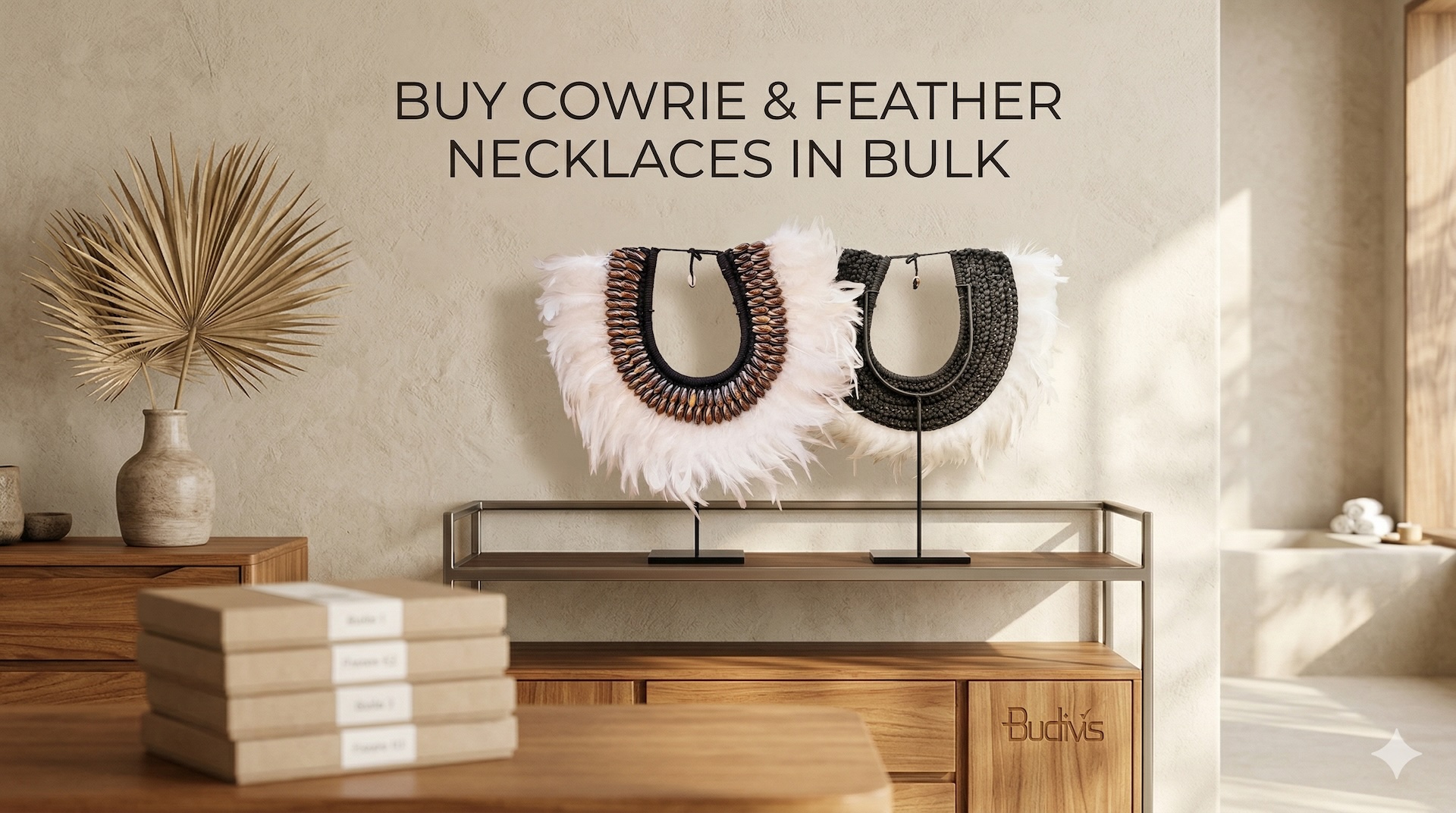
Where to Buy Cowrie Shell & Feather Necklace Display in Bulk – Trusted Bali Wholesale Supplier for Importers
Product IdentityThe cowrie shell & feather necklace display on stand is one of the most in-demand decorative pieces in the global boho, tribal, and coastal home décor market. Combining natural textures with handcrafted artistry, th...
- 0
- 278

Where to Buy Sunburst Shell Sculpture on Stand in Bulk
Coral Spike Ring Shell Necklace on Stand BV10584 Elevate your interior collection with this stunning sunburst-style shell sculpture, meticulously handcrafted by Bali artisans using authentic coral spikes and cowrie shells. This p...
- 0
- 229

Why Cowrie Shell Statement Necklace Decor Is Trending in Coastal Interiors – A Must-Have for Importers & Home Decor Buyers
Discover the handcrafted detail of this Bali Tribal Necklace Big Cowrie Shells design, created for wholesale buyers, importers, retailers, resellers, and online sellers targeting lifestyle, boho, coastal, and ethnic decor markets. This export-ready s...
- 0
- 404

Where to Buy Cowrie Shell Necklace Display in Bulk – Trusted Bali Supplier for Importers
Ocean Ring Shell Necklace Display | Papua Decor Ocean Ring Shell Necklace on Stand, Natural Coastal Wall Accent Display Décor, Papua Cowrie Shell Necklace Display I...
- 0
- 312