
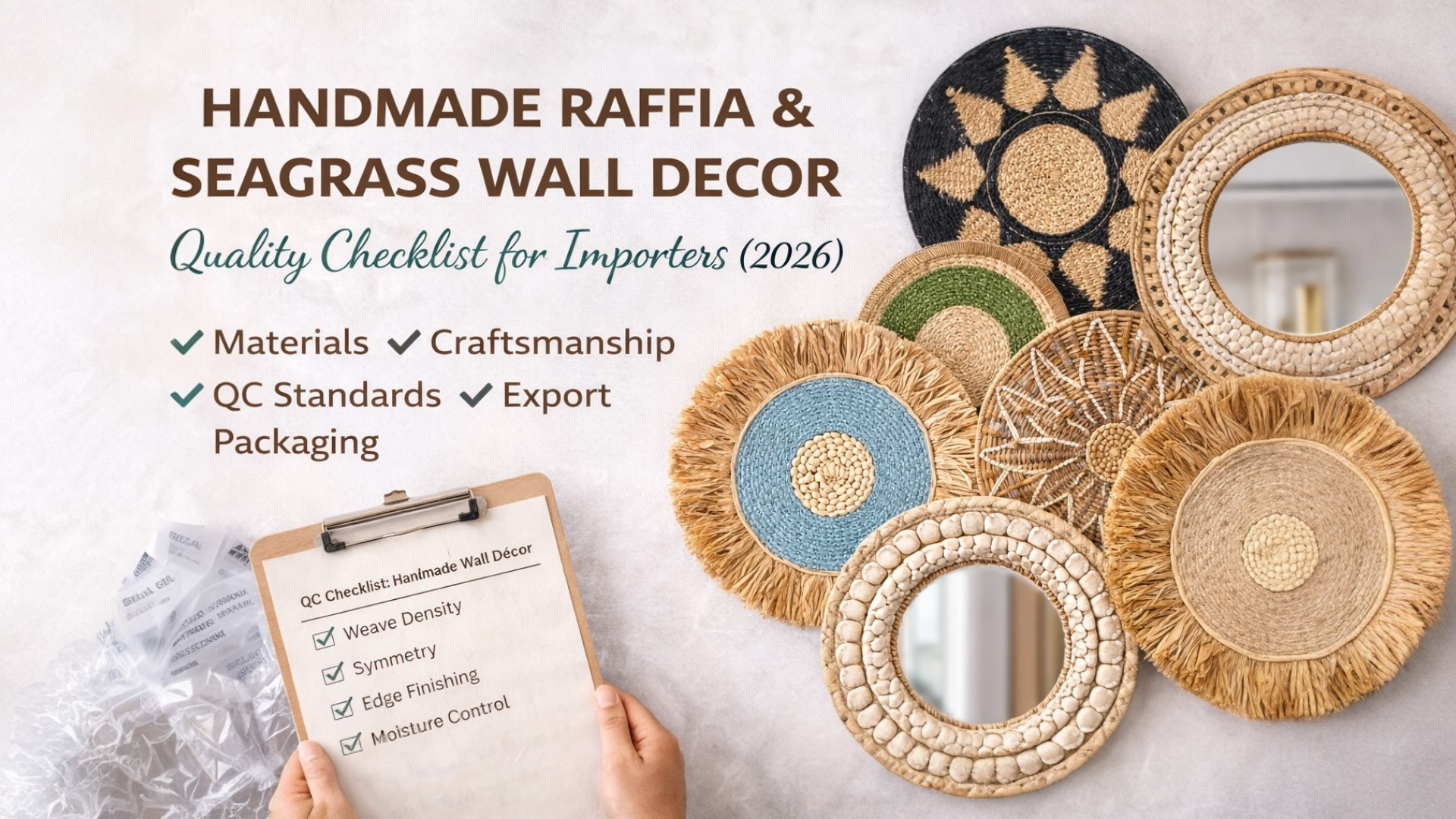

For importers, galleries, and professional buyers, “handmade” is not just a marketing word—it’s a standard that must be verified. Natural-fibre wall décor like raffia fringe wall hangings, seagrass wall baskets, and woven wall plates can be incredibly durable, premium-looking, and profitable. But it can also become a costly headache if moisture control, weave consistency, finishing, and packaging are not handled correctly.
This article is your quality and sourcing checklist for buying handmade raffia and seagrass wall decor at wholesale scale—especially if you supply home décor retailers, online resellers, interior projects, villas/hotels, event wholesalers, or art galleries. We’ll cover materials, craftsmanship standards, QC checkpoints, packaging, and how to communicate natural variations without increasing returns.
Recommended articles read may you like:
“seagrass wall basket decor wholesale buying guide for retailers and importers”
“boho woven wall baskets 2026 styles, sizes, and trending patterns”
“hotel & villa wall decor ideas using seagrass and raffia wall art”
“how to sell woven wall basket sets online (bundles, photos, keyword strategy)”
1) Materials 101: What You’re Actually Buying
Understanding materials helps you predict performance, pricing, and shipping requirements.
Seagrass
A strong natural fibre commonly used in baskets and mats.
- Strength: high (good for structure)
- Texture: slightly coarse, visible weave
- Colour: natural tan to light brown, may vary by season
- Best use: wall baskets, flat weave plates, structured designs
Importer note: seagrass must be properly dried before packing to prevent musty smell and mould.
Raffia
A softer fibre used for decorative effects—especially fringe.
- Strength: medium (best for decorative outer edges)
- Texture: soft, dramatic movement, “luxury boho” feel
- Colour: pale straw to golden tones
- Best use: fringe wall hangings, statement “sun” plates, layered texture designs
Importer note: raffia is more sensitive to humidity than seagrass—packaging needs moisture control.
Additional accents (commonly used)
- Cotton thread (for pattern stitching / contrast)
- Bamboo strips (structure and rim reinforcement)
- Cowrie shells / beads (premium category: mirrors and statement pieces)
For galleries, these accents can raise perceived value—but only if they’re cleanly finished and consistent.
2) Craftsmanship Standards: What “Good Handmade” Looks Like
When handmade wall décor is premium, you can see it immediately. Here’s what to inspect:
A) Weave density and uniformity
- Tight weave (no “holes” that look unfinished)
- Consistent tension (no warped circles)
- Balanced thickness across the piece
Red flag: loose sections or uneven tightness—often leads to distortion during shipping or hanging.
B) Symmetry and centering
For ring and target designs, the centre must be aligned.
- centred motifs
- consistent spacing
- symmetrical pattern balance
Red flag: off-centre patterns make sets look messy on a wall and lower perceived value.
C) Edge finishing (especially for fringe)
Fringe should be:
- evenly cut
- consistent density
- securely attached (no shedding)
Red flag: uneven fringe lengths and thin edges—looks cheap and increases customer complaints.
D) Backing and hanging hardware
Professional-grade wall décor needs:
- flat backing so it sits flush
- strong hanging loop (well-stitched)
- consistent placement (so sets align easily)
Red flag: weak hanging loops or inconsistent placement—causes installation problems in hotels and retail displays.
3) Quality Checklist: Importer-Level QC Points
Use this checklist before approving production, before packing, and before shipping.
Pre-production sample approval
✅ Confirm exact:
- diameter sizes (tolerance range: ±1–2 cm for handmade)
- colour tone range (natural variation rules)
- pattern placement and thickness
- weave density standard
- edge finishing standard
- hanging loop placement
In-line QC (during production)
✅ Spot check:
- tension consistency (flat circles)
- clean pattern lines
- no broken fibres
- no stains or glue marks
- consistent fringe cut
Final QC (before packing)
✅ Confirm:
- dryness (no damp smell)
- no visible mould spots
- no sharp protruding fibres (for hospitality safety)
- hanging loops secure
- set consistency (tone and pattern match across set pieces)
4) Moisture Control & Packaging: The Make-or-Break Factor
Most quality problems in natural fibre décor happen after production—during storage or shipping.
Packaging standards for export shipments
For wholesale orders (especially sea freight), require:
- inner poly bag protection (dust control)
- silica gel/desiccant inside cartons
- strong export cartons with corner protection
- separator sheets for mirrors/shell items
- clear outer carton labelling (SKU, size, set count)
Container & warehouse best practice
- avoid storing in high humidity zones
- keep cartons off the floor (pallets)
- ventilate storage space where possible
Importer reality: If a supplier is excellent at weaving but weak at packaging, you can still lose the shipment to mould or odour complaints. Packaging is part of quality.
5) Set Consistency: The Gallery and Retail Standard
Retailers and galleries often display wall baskets as curated sets. This means “matching” matters.
How to standardise handmade sets
- Use the same fibre batch for each set when possible
- Standardise pattern templates
- Keep tone consistent across set pieces (within a defined natural range)
- Use a quality control “set matching” step before boxing
Pro tip for galleries: Offer “collection names” (e.g., Coastal Neutral Series, Tribal Contrast Series). This makes it feel curated and collectible.
6) How to Communicate Natural Variations Without Increasing Returns
Natural fibre décor will never be identical. The goal is to make variation feel like a premium feature, not a defect.
Include this in product listings:
- “Handmade item—slight variations in weave and tone are normal.”
- “Natural fibres may show unique textures and colour changes seasonally.”
- “Sizes may vary slightly (±1–2 cm) due to handcrafted production.”
For high-end buyers, these statements increase perceived authenticity.
7) Compliance & Professional Buyer Requirements
Depending on your market, buyers may ask about:
- material origin
- handmade production process
- ethical sourcing
- packaging standards
- care instructions
Even simple documents help:
- product care sheet
- packing list with SKUs and set breakdown
- brief “artisan story” card for retail/galleries
Conclusion: The Importer’s Advantage Is Quality Control
Handmade raffia and seagrass wall décor is a powerful category for importers and galleries because it’s lightweight, photogenic, and instantly elevates interiors. But long-term success depends on verifying craftsmanship and enforcing professional packaging standards—especially moisture control, weave consistency, and set matching.
If you supply online retailers, resellers, villas/hotels, event wholesalers, importers, or galleries, Budivis supports your sourcing with affordable wholesale pricing, 100% handmade production in Bali, and worldwide shipping. We also provide custom designs, private label packaging, and export-ready packing—so you can build a consistent collection that performs in retail and hospitality projects.
Related Products

Beaded Cactus Tourques White Wall Art, Natural Rope Cowrie Shells Wall Hanging Décor, Bohemian Wall Hanging
Wholesale Direct Artisans Beaded Cactus Tourques White Wall Art, Natural Rope Cowrie Shells Wall Hanging Décor, Bohemian Wall HangingBring authentic island craftsmanship to your store with Budivis Wholesale Handmade Cowrie Shell Wall Decor. This...

Beaded Turtle Tourques White Wall Art, Handmade Boho Coastal Round Wall Art Beaded Décor, Bohemian Wall Hanging
Wholesale Direct Artisans Beaded Turtle Tourques White Wall Art, Handmade Boho Coastal Round Wall Art Beaded Décor, Bohemian Wall HangingBring authentic island craftsmanship to your store with Budivis Wholesale Handmade Cowrie Shell Wall Decor. ...

Boho Minimalist Beaded Wall Art Decor, Mandala Bead Wall Hanging Décor, Wall Art Tropical Boho Wall Decoration
Wholesale Direct Artisans Boho Minimalist Beaded Wall Art Decor, Mandala Bead Wall Hanging Décor, Wall Art Tropical Boho Wall DecorationBring authentic island craftsmanship to your store with Budivis Wholesale Handmade Cowrie Shell Wall Decor. T...

Beaded Beige White Wall Art, Natural Rope Cowrie Shells Wall Hanging Décor, Bohemian Wall Hanging Home Décor
Wholesale Direct Artisans Beaded Beige White Wall Art, Natural Rope Cowrie Shells Wall Hanging Décor, Bohemian Wall Hanging Home DécorBring authentic island craftsmanship to your store with Budivis Wholesale Handmade Cowrie Shell Wall Decor. Thi...

Boho Straw Wall Art, Handwoven Beaded Shells Cactus Tree Wall Art, Coastal Beach House Living Room Decoration
Wholesale Direct Artisans Boho Straw Wall Art, Handwoven Beaded Shells Cactus Tree Wall Art, Coastal Beach House Living Room DecorationBring authentic island craftsmanship to your store with Budivis Wholesale Handmade Cowrie Shell Wall Decor. Th...

Bohemian Loly Pop Beaded Wall Art Decor, Mandala Bead Wall Hanging Décor, Wall Art Tropical Boho Wall Decoration
Wholesale Direct Artisans Bohemian Loly Pop Beaded Wall Art Decor, Mandala Bead Wall Hanging Décor, Wall Art Tropical Boho Wall DecorationBring authentic island craftsmanship to your store with Budivis Wholesale Handmade Cowrie Shell Wall Decor....

Shell Statement Art Wall Decor, Coastal Beaded Cowrie Shell Crab Art, Wall Plaque Boho Chic Bedroom Wall Decor
Wholesale Direct Artisans Shell Statement Art Wall Decor, Coastal Beaded Cowrie Shell Crab Art, Wall Plaque Boho Chic Bedroom Wall DecorBring authentic island craftsmanship to your store with Budivis Wholesale Handmade Cowrie Shell Wall Decor. T...

Boho Straw Wall Art, Handwoven Beaded Shells Coco Tree Wall Art, Coastal Beach House Living Room Decoration
Wholesale Direct Artisans Boho Straw Wall Art, Handwoven Beaded Shells Coco Tree Wall Art, Coastal Beach House Living Room DecorationBring authentic island craftsmanship to your store with Budivis Wholesale Handmade Cowrie Shell Wall Decor. This...

Beaded White Black Wall Art, Natural Rope Cowrie Shells Wall Hanging Décor, Bohemian Wall Hanging Home Décor
Wholesale Direct Artisans Beaded White Black Wall Art, Natural Rope Cowrie Shells Wall Hanging Décor, Bohemian Wall Hanging Home DécorBring authentic island craftsmanship to your store with Budivis Wholesale Handmade Cowrie Shell Wall Decor. Thi...

Shell Wall Art, Straw Beaded Shells Mandala Wall Hanging Large Round Boho Accent Piece, Natural Seagrass Wall Art
Wholesale Direct Artisans Shell Wall Art, Straw Beaded Shells Mandala Wall Hanging Large Round Boho Accent Piece, Natural Seagrass Wall ArtBring authentic island craftsmanship to your store with Budivis Wholesale Handmade Cowrie Shell Wall Decor...
Related Blog

Hotel & Villa Wall Decor Ideas: How to Style Seagrass and Raffia Wall Art for Coastal, Bohemian, and Tropical Interiors (2026)
In hospitality design, wall décor is not just decoration—it’s part of the guest experience. A villa bedroom that feels warm and curated gets better reviews. A resort lobby with a signature photo wall gets more Instagram shares. Even a small boutique ...
- 0
- 344

Enhance Your Space with Natural Woven Bamboo and Rattan Décor: A Trend That’s Here to Stay
In the world of home décor, natural materials like bamboo, rattan, and seagrass continue to rise in popularity, offering a unique blend of sustainability, timeless design, and rustic charm. Whether you're designing a bohemian living ro...
- 0
- 299

Straw Wall Art with Beaded Shells Decor: A Complete Guide for Buyers, Resellers, and Interior Brands
Straw wall art with beaded shells decor is more than just a decorative trend—it is a blend of natural materials, handmade craftsmanship, and timeless coastal-boho style. This type of wall décor combines woven straw or seagrass with shells and bead ac...
- 1
- 394

Seagrass Wall Basket Decor Wholesale: Complete Buying Guide for Retailers, Resellers, and Importers (2026)
Seagrass wall basket décor has become one of the most reliable “evergreen” categories in natural home styling. It sells well because it checks every box modern buyers care about: natural texture, handmade authenticity, neutral colours, lightweight shi...
- 0
- 321

How to Sell Woven Wall Basket Sets Online: Product Bundles, Photography Tips, and Keyword Strategy for Resellers (2026)
Woven wall baskets are one of the easiest home décor products to sell online—if you package them the right way. The biggest difference between a slow listing and a best-seller is rarely the product itself. It’s usually the presentation: the bund...
- 0
- 336

Boho Woven Wall Baskets for Home Decor Stores: Best Styles, Sizes, and Trending Patterns for 2026
Boho woven wall baskets are no longer “just a trend”—they’ve become a core wall décor category for online retailers, boutique stores, home décor resellers, villas/hotels, event stylists, importers, and art galleries. Why? Because they deliver in...
- 0
- 399